
“Dyslexic people are creative, out-of-the-box thinkers. They have to be, because they do not see or solve problems the way other people do. It is not a bad thing to be different. Sometimes it’s the mark of being very, very talented.” – Rick Riordan
“Dr. Dickson has an uncanny ability to understand people and situations, to “sense” them within a few seconds of encountering the person or witnessing a situation. Simply put, her mind works on a different level than the rest of us and having her on my side, helping me through my issues, is invaluable to me.” – Prior client
Dyslexic thinking is often misunderstood as a limitation, but in reality, it can be a powerful strength. People with dyslexia tend to think in images, connect ideas in unconventional ways, and approach problems with creativity that others may overlook. These abilities can lead to innovation, insight, and unique solutions—qualities that are often undervalued in traditional education systems. My own journey with dyslexia shows how what was once seen as a disability became the foundation of my success.
I always thought thinking in pictures and quickly identifying connections between unrelated ideas was something everyone could do and was shocked when people called me “gifted,” “brilliant,” or “intelligent.” But that wasn’t always the case. As a child, people believed I had low intelligence.
When I started kindergarten, I was placed in special education—even though, at age five, I had already won an award for the most creative drawing in elementary school. Every day I was pulled out of class for two hours of one-on-one instruction and put in the lowest learning group.
By 3rd grade, I still couldn’t read. When my report card came back filled with 1’s, I proudly thought I was “#1,” not realizing it meant I had failed. The school recommended I be held back. My father was convinced the public school had failed me so I was transferred to private school for 4th grade.
In the 1980s, special education services did little to identify or address dyslexia. Dyslexia makes it difficult to read and interpret letters, words, and symbols, yet at the time it was poorly understood.
Since the private school I attended had no special education program, my grandparents stepped in. Everyday after school from 3:00 PM – 5:00 PM they patiently re-taught me my school lessons in their tiny kitchen.

From 4th through 8th grade, my grandparents were my tutors. Though they had only completed school through the 8th grade themselves, they were disciplined, creative, and compassionate. They taught me to read by memorizing words out of a pocket dictionary. By the end of 4th grade, I was reading at grade level but they continued to remediate me through 8th grade, and every summer until I turned 17, they bribed me to complete the summer reading program at the library.
Their unconventional teaching worked. When I returned to public school in 5th grade, I tested at grade level and no longer needed special education services. Still, my grandparents continued tutoring me after school. I never had an IEP or received accommodations in public school or later in college.
Technology was my saving grace. When computers became widely available at age 18, I leaned heavily on spelling and grammar software. This helped me overcome my continued difficulties with spelling.
When I entered college, I failed the English proficiency test and was placed in remedial English. But in math, I tested into advanced calculus. As I gained confidence in using writing software, I enrolled in an advanced expository writing course. For the first time, my dyslexic way of thinking—creative, abstract, and unconventional—was celebrated.
The English department valued my ability to analyze texts critically and generate creative, compelling arguments. Professors used my papers as teaching examples and invited me to lead small group sessions. I went from feeling unsure of my abilities to becoming a star student and was even hired by the university as an expository writing tutor at four times the minimum wage.
My professors encouraged me to pursue a Ph.D. in English literature. But my passion was psychology. I wanted to help people and organizations analyze their problems and discover new, creative solutions. Dyslexic thinking—once my greatest struggle—had become my greatest strength, and it continues to influence my work as a psychologist today.
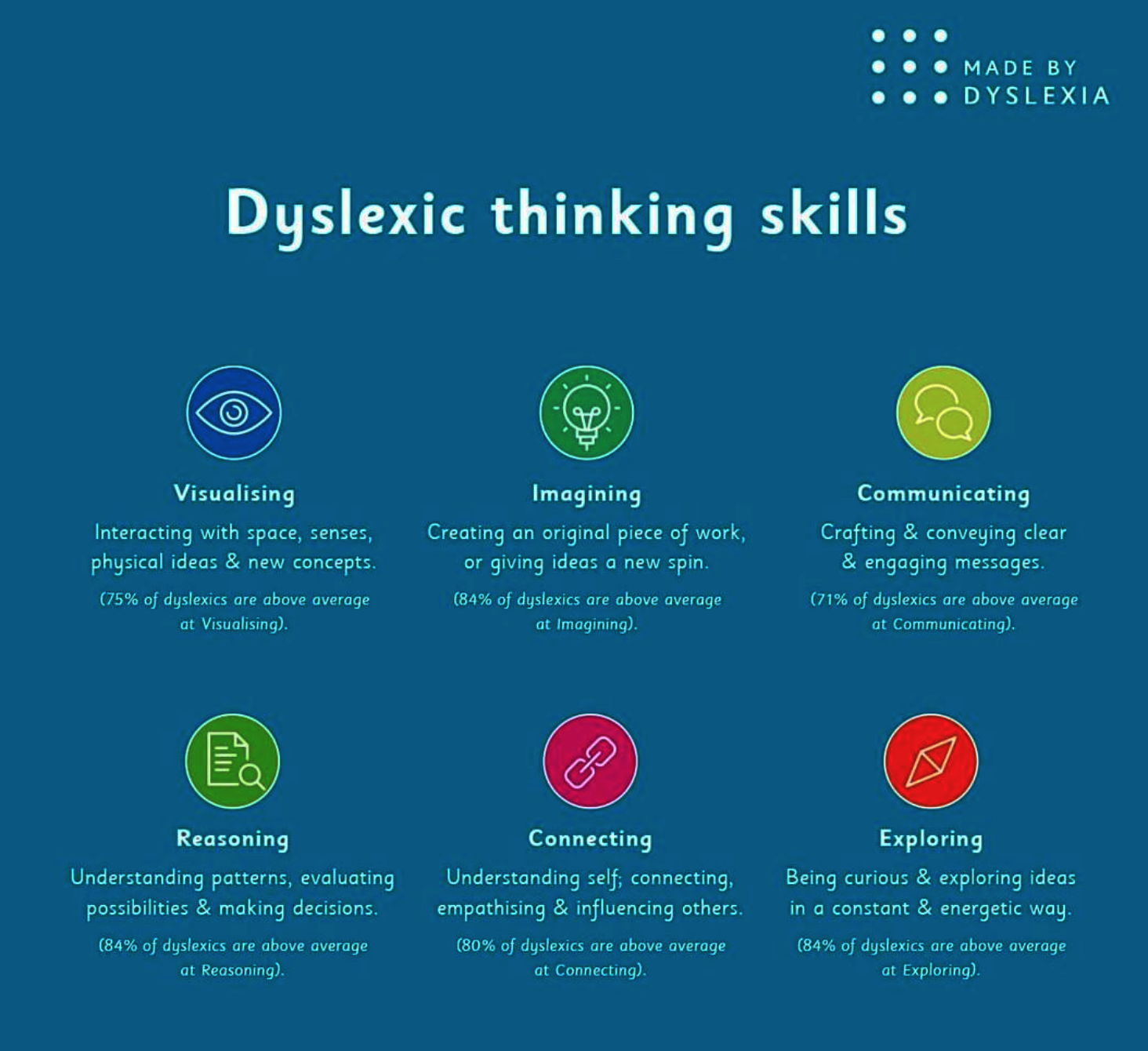
Dyslexic Thinking Skills
Final Thoughts
Looking back, I see that I wasn’t disabled—the school system was. The “one-size-fits-all” approach to education failed me, as it still fails millions of children today. If schools embraced project-based learning, many so-called “learning disabilities” would no longer exist.
Diversity in learning should be valued, not dismissed. Yet traditional education systems, including the current “common core,” demand memorization and standardized methods. No wonder over 85% of students say they dislike school.
Children with dyslexia often struggle to keep up in this system. We take longer to process the written word, and we tune out during long lectures. Many are misdiagnosed with ADD/ADHD and medicated simply to fit into a rigid system. But medicating children is not the solution. Changing the system is.
Until the educational system evolves, children who learn differently will continue to feel like the problem. They will be labeled, accommodated, and pushed to fit into a model that values conformity over creativity. And in the process, their unique gifts may never be seen, nurtured, or realized.
Contact Me
If your child struggles with a “learning difference” and needs help building his or her self-confidence as well as identifying his or her unique gifts and talents, please reach out to me for an appointment. I am here to help.
Additional Resources
Below are some of my favorite resources for children diagnosed with dyslexia.
Yale Center for Dyslexia and Creativity
About the Author
Dr. Christine E. Dickson is a licensed clinical psychologist (CA PSY20050) with Dual PhDs in Clinical and Industrial-Organizational Psychology. Known for her creative, out-of-the-box approach, she draws on both scientific expertise and her own experience with dyslexia to help clients find innovative paths to growth. Dr. Dickson specializes in working with adults, adolescents, and organizations—integrating evidence-based methods such as mindfulness based cognitive behavioral therapy with her unique capacity for creative analysis. Her work emphasizes the value of diversity in learning and thinking, challenging the “one-size-fits-all” model of education and encouraging new ways to honor human potential.

Leave a Reply